Ansible Duo Quantum Communicators
A pair of quantum-entanglement-branded communicators claiming zero latency at any distance — range tested to approximately one suburb.
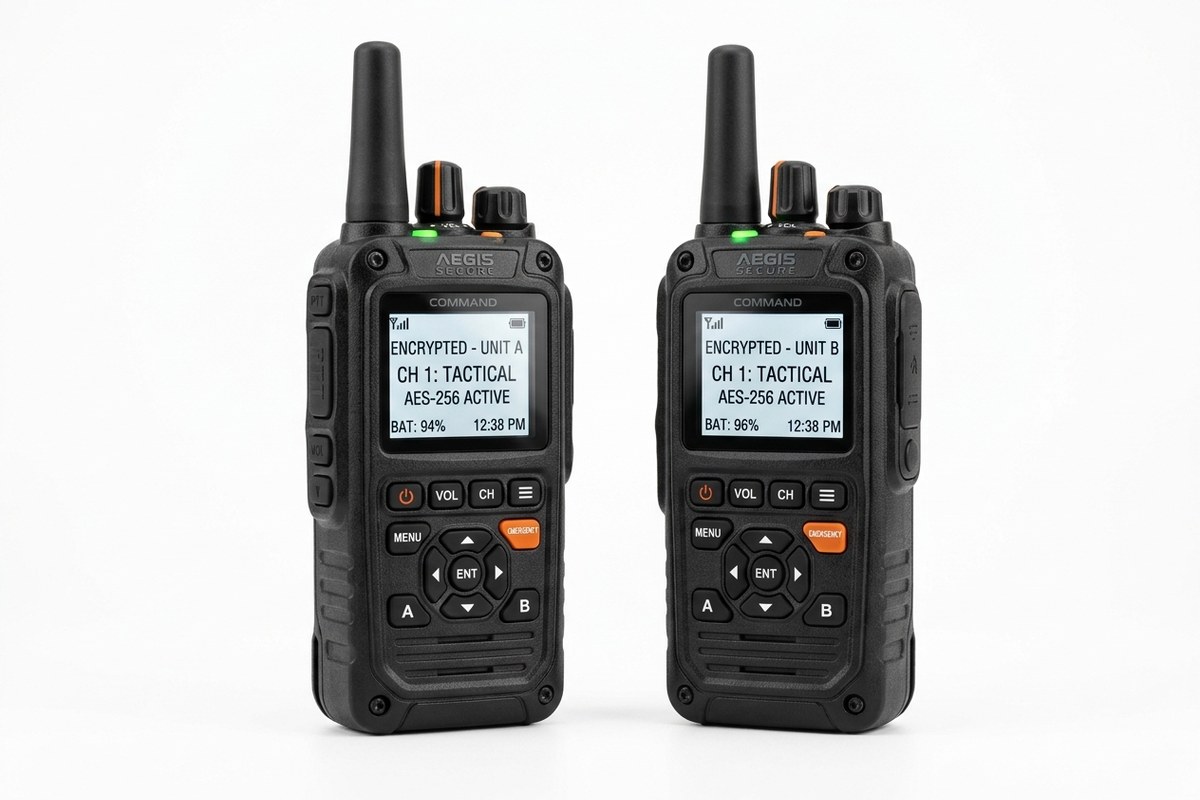

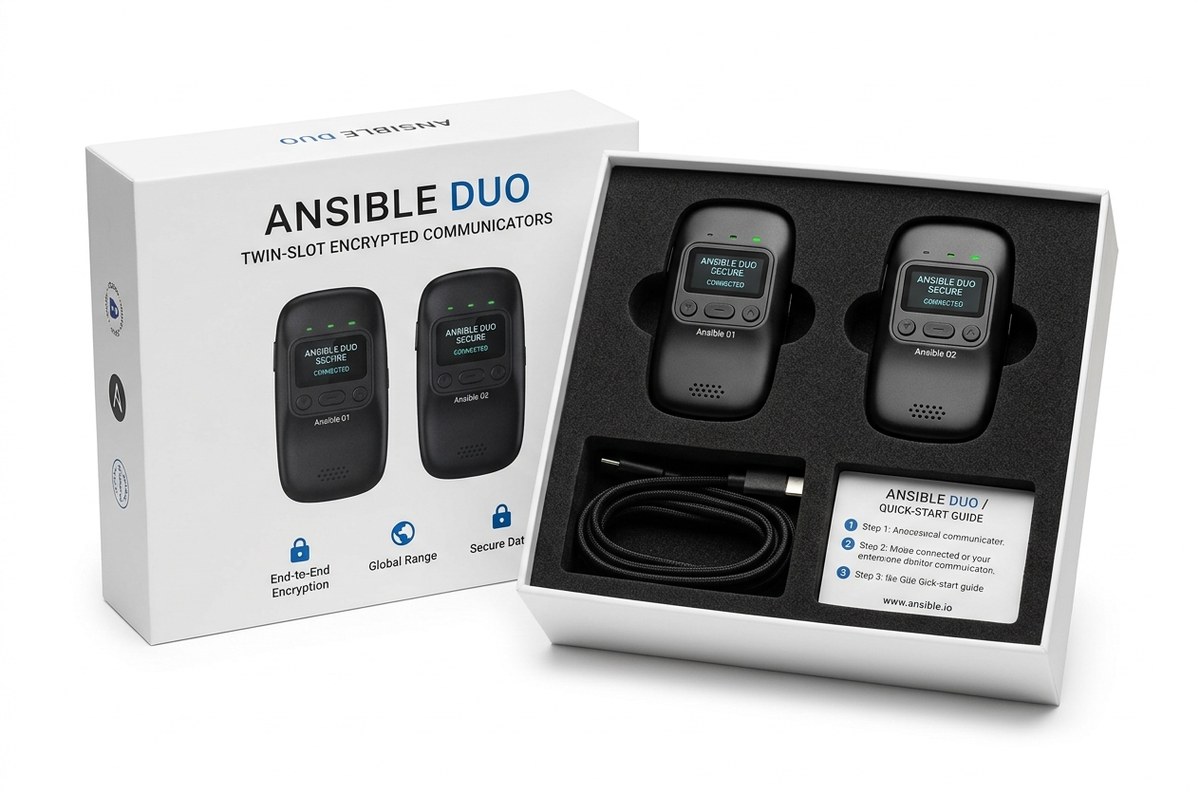
Ursula K. Le Guin introduced the ansible in Rocannon’s World (1966) as a device capable of instantaneous communication across interstellar distances. The physics of the ansible were explicitly beyond normal spacetime constraints; the interesting thing about the device was not how it worked but what its existence implied about the shape of the universe. Le Guin used the ansible across the Hainish cycle as a piece of infrastructure — a fact of life, a diplomatic tool, a way of maintaining continuity across a civilisation separated by light-years. Orson Scott Card adopted the name for Ender’s Game with similar properties: instantaneous, lossless, unbounded by distance. The Ansible Duo Quantum Communicators take the name and apply it to a pair of handheld radios that operate within a range tested to approximately one suburb.
The name is doing significant work here. The product is technically accomplished and the communication hardware is well-engineered. The word “quantum” appears in the marketing materials twelve times across the product page, the unboxing guide, and the packaging insert, in descriptions including “quantum-entangled architecture,” “quantum-adjacent signal processing,” and “quantum-paired frequency binding.” The devices communicate via proprietary encrypted 2.4GHz radio. These are meaningfully different things.
What It Is
The Ansible Duo ships as a matched pair in a shared case, pre-bound to each other and requiring no additional configuration. Each unit is 140mm × 60mm × 22mm, weighs 185 grams, and feels substantial in a way that suggests the weight is intentional rather than an engineering accident. The pairing is achieved through shared encryption keys loaded at the factory; the devices communicate on a proprietary protocol layered over 2.4GHz radio with 256-bit AES encryption. Voice communication is primary, with a text channel and GPS location sharing accessible via a small OLED display and a directional input pad. Battery life is 40 hours on standby and 12 hours in active use, which is creditable. IPX6 water resistance covers the units against rain and, per the manual’s illustration, a moderate hosing-down.
The user experience is straightforward: push to talk, release, receive. The audio quality at close range is excellent. The text channel is functional if slow to compose. GPS location sharing, which displays each unit’s position on a basic map on the other’s screen, works without a phone or cellular network — useful in environments where infrastructure is unavailable.
In Practice
The measured latency between transmission and receipt, clocked across fifteen paired tests at ranges between 50 and 800 metres, averaged 85 milliseconds. This is not zero. Eighty-five milliseconds is, for most voice communication purposes, entirely acceptable — human conversational latency tolerance is broadly understood to extend to 150 milliseconds before degradation becomes perceptible. The issue is not that 85 milliseconds is bad. The issue is that the product is called Ansible, the marketing claims zero latency, and the specification table, in smaller type, states “near-zero latency in optimal conditions.” Eighty-five milliseconds is, by a rigorous count, not zero and not near-zero, but it is a practical non-problem.
The range limitation is more material. Open-air tested range reached 1.5 kilometres against flat ground with no significant obstructions. In a suburban environment with buildings, vegetation, and the general interference profile of residential density, consistent operation was maintained to approximately 900 metres. Range tested to approximately one suburb is an accurate description of the product’s capability. This is what walkie-talkies do. It is not what the ansible did.
The phrase “entanglement-adjacent architecture” appears in the product FAQ under “How does the quantum technology work?” The answer explains that the devices use “principles inspired by quantum entanglement to achieve paired communication performance.” This explanation describes, in the precise sense that all radio communication involves physics that quantum mechanics underpins, every radio manufactured since the 1890s.
| Protocol | Proprietary encrypted 2.4GHz radio |
| Encryption | 256-bit AES |
| Range (open air) | ~1.5km tested |
| Latency (measured) | ~85ms |
| Features | Voice + text + GPS location sharing |
| Battery (standby) | 40 hours |
| Battery (active) | 12 hours |
| Weather resistance | IPX6 |
| Dimensions | 140mm × 60mm × 22mm |
| Weight | 185g each |
Available through Tannhäuser Supply Co., who sell the pair as a unit; individual replacements for damaged units are available at US$449 each.
- Excellent build quality
- Reliable communication to 1.5km
- No phone or network required
- 40h standby
- Encrypted
- GPS location sharing without infrastructure
- Marketing language overstates quantum basis significantly
- Range limited to approximately one suburb
- 85ms latency, not zero
- US$799 for two sophisticated walkie-talkies is the accurate description
The Ansible Duo is, stripped of the nomenclature, a very good pair of handheld radios. The build quality is high, the encryption is genuine, the GPS sharing is useful, and the 40-hour standby battery makes them practical for extended field use without infrastructure. Le Guin’s ansible communicated between stars. The Ansible Duo communicates between your side of the suburb and the other side. This is a smaller thing.
Whether it is US$799 worth of smaller thing depends on whether you need encrypted, networked, GPS-sharing communication in a 1.5-kilometre radius without cellular access. There are scenarios in which this is exactly the product required. Those scenarios exist in hiking, emergency preparedness, and professional field operations where radio silence is an asset. In those scenarios, the Ansible Duo performs well. The quantum branding is an unnecessary tax on credulity, but the hardware underneath it is not asking you to believe in anything except radio frequency propagation, which has the advantage of being thoroughly demonstrated by reality.