bHaptics TactSuit X40
A haptic feedback vest with 40 actuators covering the torso — the tactile layer that VR still largely lacks, delivered as a vest you wear over your clothes.
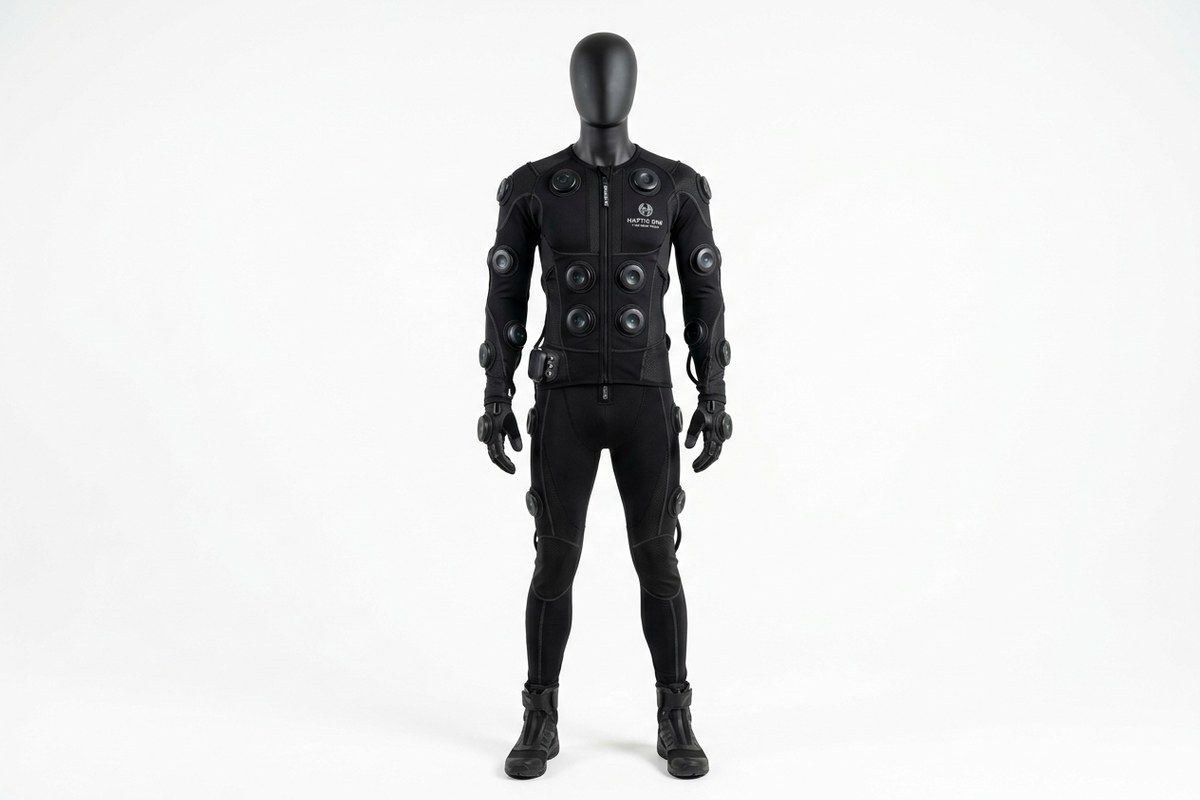
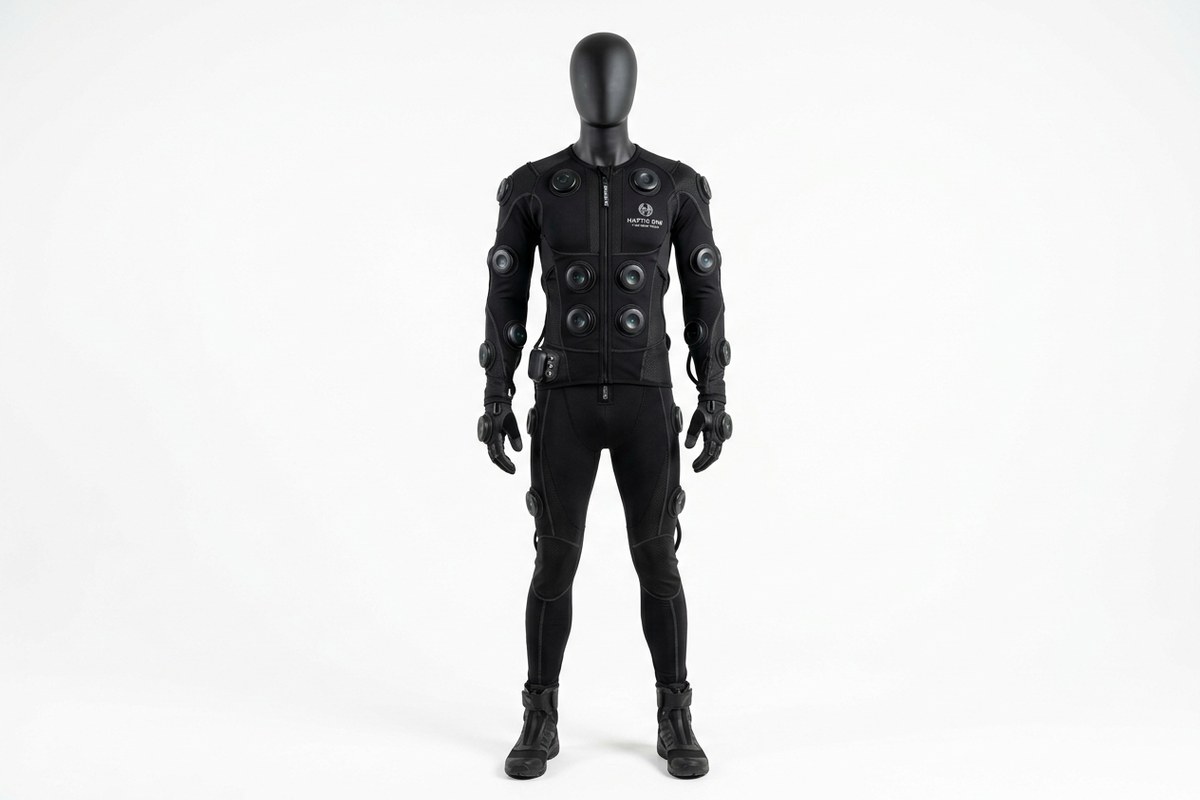
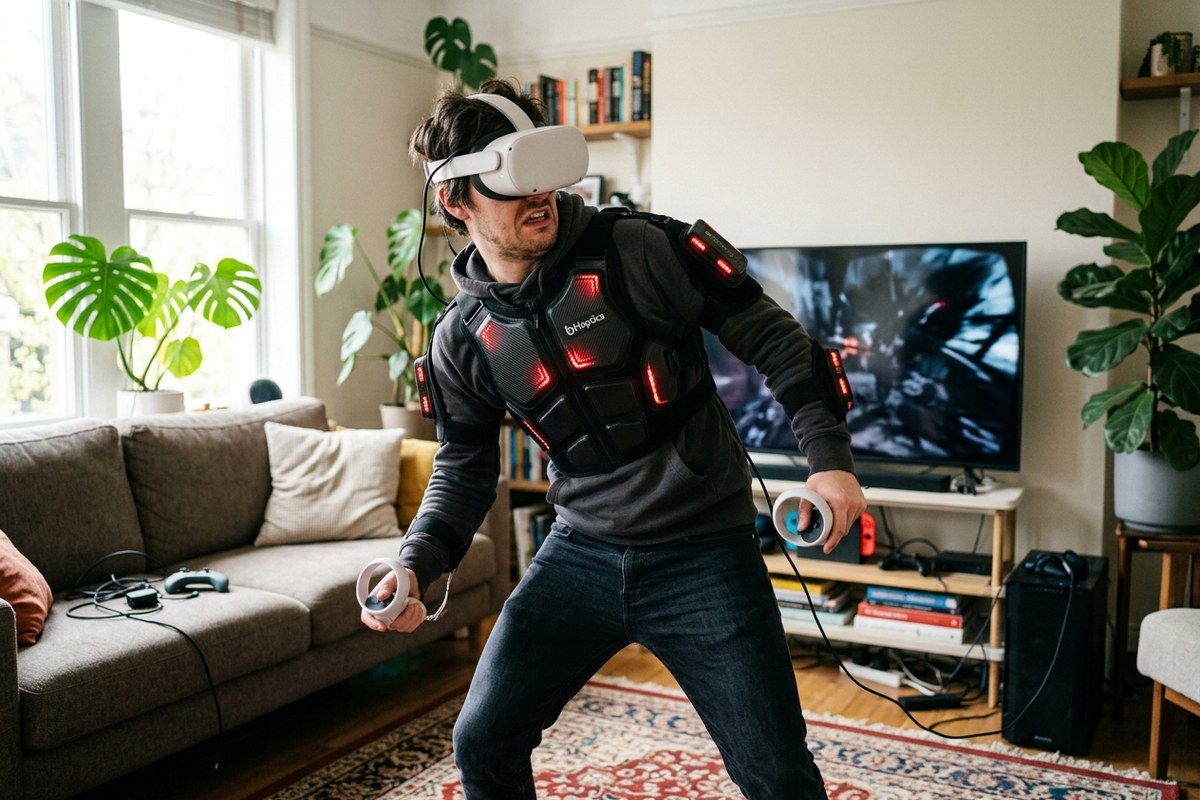
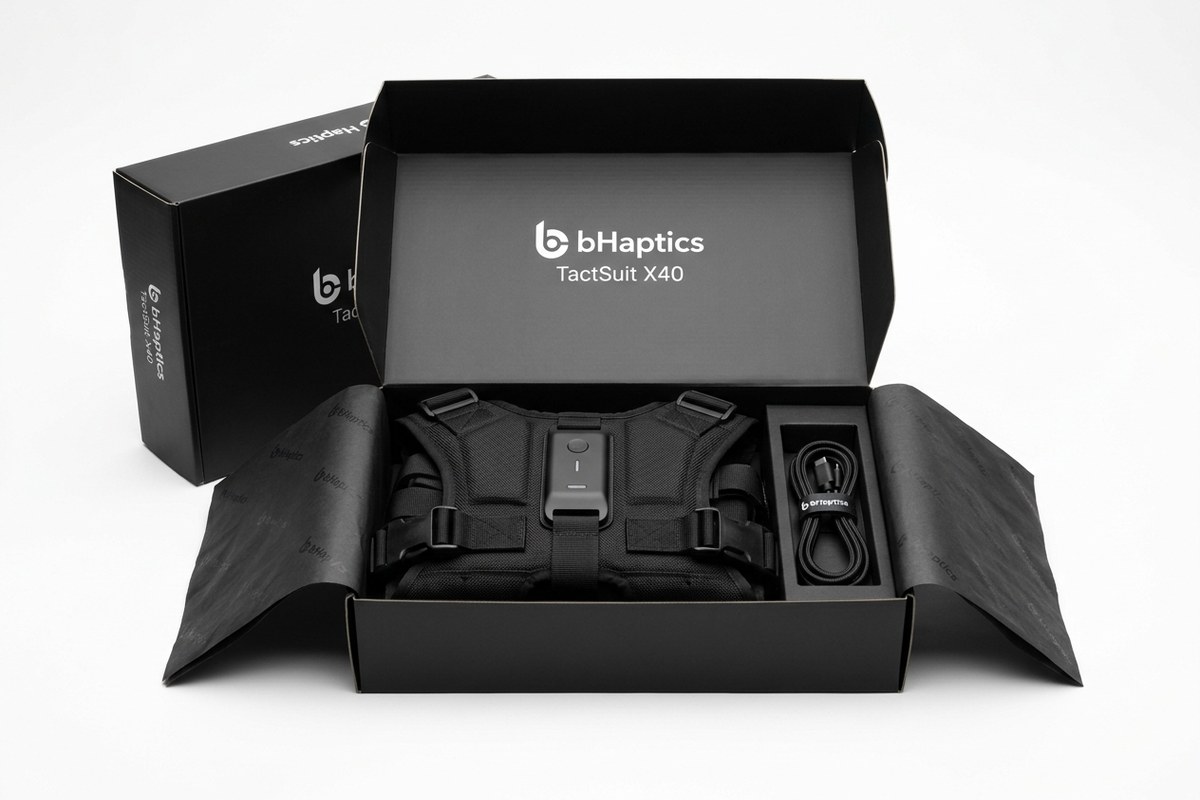
In Ready Player One (2011), Ernest Cline’s characters suit up in haptic rigs that translate the physical sensations of the OASIS — hits, falls, textures, ambient contact — into full-body feedback. The technology is described with the casual specificity of a world in which it has become consumer infrastructure, which is to say: everyone has it, it works completely, and nobody discusses charging. This is fiction’s traditional dispensation, and it is not entirely available in 2025. What is available is the bHaptics TactSuit X40, which covers the torso, charges via USB-C, and does a meaningful approximation of the tactile layer that current VR otherwise skips entirely.
The gap between the haptic suit of the OASIS and the TactSuit X40 is real but narrower than the genre might suggest. The X40 is not full-body. It is not neural. It will not simulate the sensation of rain or the warmth of a fire. It will, when a bullet strikes your character in a supported game, vibrate the corresponding actuator on your chest or back with sufficient spatial precision that you can identify the direction of the hit without looking at your health bar. This is useful in a way that takes about fifteen minutes to internalise and about fifteen sessions to stop noticing as a novelty.
What It Is
The X40 is a vest with 20 eccentric rotating mass (ERM) actuators on the front and 20 on the back, for 40 total. Each actuator can be individually addressed, which allows the system to represent spatially distributed events — an explosion to the left, a point impact on the right shoulder, ambient vibration from machinery — rather than the single-channel whole-body rumble that game controllers have used for decades.
The vest connects to the host PC or headset via Bluetooth 5.0, draws power from a built-in battery rated for approximately six hours, and charges fully in about two hours via USB-C. It weighs 600 grams, which is light enough to forget you are wearing it under normal conditions.
The bHaptics SDK is available for developers, and over 100 VR titles have integrated it at time of writing. Integration quality varies by title: some developers have mapped haptic events carefully, producing feedback that adds meaningfully to the experience; others have mapped it cursorily, producing feedback that is technically present but spatially implausible.
In Practice
The cases for the X40 are strongest in combat titles and atmospheric exploration games. In an archery VR game, feeling the bowstring’s snap on your chest is immediately plausible in a way that requires no adjustment. In a horror title, low-frequency haptic events timed to ambient sound design produce a physical component to tension that is difficult to achieve through visual and audio channels alone.
The thermal behaviour is worth disclosing directly: the vest becomes warm under sustained use. At 30 minutes, the temperature is noticeable. At 60 minutes, it is enough to make you aware of the fabric against your back in a way that interrupts immersion more than haptic events do. At 90 minutes in a heated room, it is the primary physical sensation you are managing. The ERM actuators generate heat as a byproduct of operation, and the vest’s construction does not dissipate it efficiently. Playing in a cool environment mitigates this significantly; playing in summer, less so.
The washing situation warrants its own paragraph, because bHaptics has buried the relevant instructions in setup documentation rather than on the product itself. The X40 is hand-wash cold, dry flat, electronics pack removed. This is not unusual for garments with embedded technology. It is unusual that the instructions appear at approximately paragraph 23 of the setup guide, well past the point at which a new owner has likely already developed preferences about laundry. Frequent VR users who wear the vest against clothing for extended sessions will find this inconvenient on a recurring basis.
| Actuators | 40 ERM (20 chest, 20 back) |
| Connectivity | Bluetooth 5.0 / USB-C |
| Battery | ~6 hours |
| Charge time | ~2 hours |
| SDK | bHaptics SDK |
| Integrated titles | 100+ at time of review |
| Weight | 600g |
Available through Tannhäuser Supply Co. with standard shipping; the electronics pack is removable before washing and the packing instructions are available online.
- Meaningful spatial haptic feedback in well-integrated titles
- 40-point resolution represents events with positional accuracy
- Growing library of supported games
- Comfortable and lightweight under normal thermal conditions
- Vest becomes warm under extended use, particularly in heated environments
- Effect depends entirely on quality of developer integration
- Torso only — arms, legs, and hands unaddressed
- Hand-wash instructions are not prominently disclosed
The TactSuit X40 is the right product for a specific buyer: someone who plays VR regularly, owns or plans to own titles from the supported library, and has a room temperature they can manage. For that buyer, the US$450 buys a hardware layer that VR headsets have not incorporated natively and that meaningfully expands the range of physical information the medium can convey. For the buyer who plays VR occasionally, in a warm room, across a mix of unsupported titles, the value proposition is thinner and the thermal situation more pronounced.
Ernest Cline’s haptic rigs have no documented temperature regulation, no disclosed maintenance requirements, and presumably no paragraph 23 in their setup guides. The market for the OASIS is, in that sense, still several product generations away. The X40 is a credible step in the right direction.