Mercer Empathy Box, Home Edition
A wellness device with two grip handles that synchronizes your mood state with other users currently holding theirs — reviewed as a meditation gadget, terms of service pending careful reading.

In Philip K. Dick’s Do Androids Dream of Electric Sheep? (1968), the empathy box is a device through which users grip two handles and merge their consciousness with Wilbur Mercer — an archetypal figure climbing a hill, facing thrown rocks, persisting. Users experience Mercer’s sensations collectively; they feel one another through the shared vision; they are physically injured when Mercer is struck by rocks, the injuries manifesting on their own bodies. The empathy box is simultaneously a religious practice, a social bond, and a form of mass experience that distinguishes humans — capable of genuine empathy — from androids, who are not. It produces shared hallucination. It produces shared wounds.
The Mercer Empathy Box, Home Edition, produces synchronized biofeedback and Peltier thermal feedback. The distance between these two things is worth acknowledging before the review proceeds.
What It Is
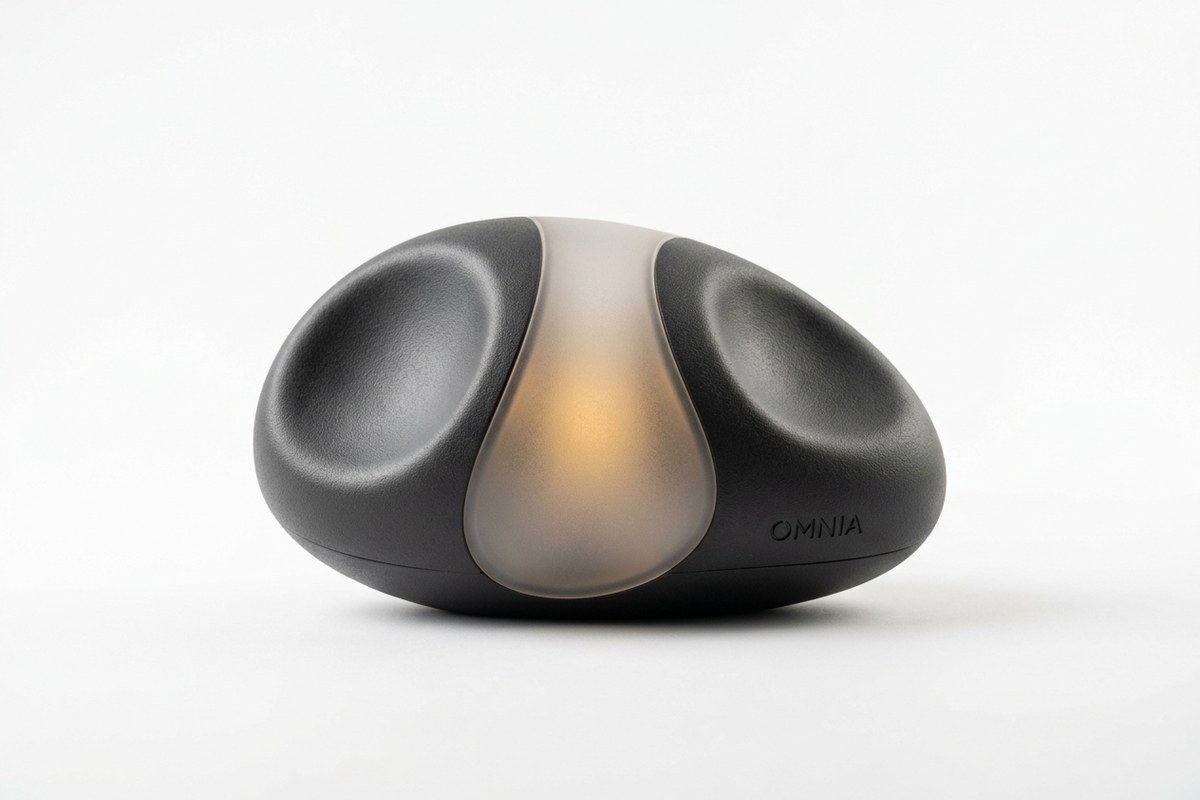
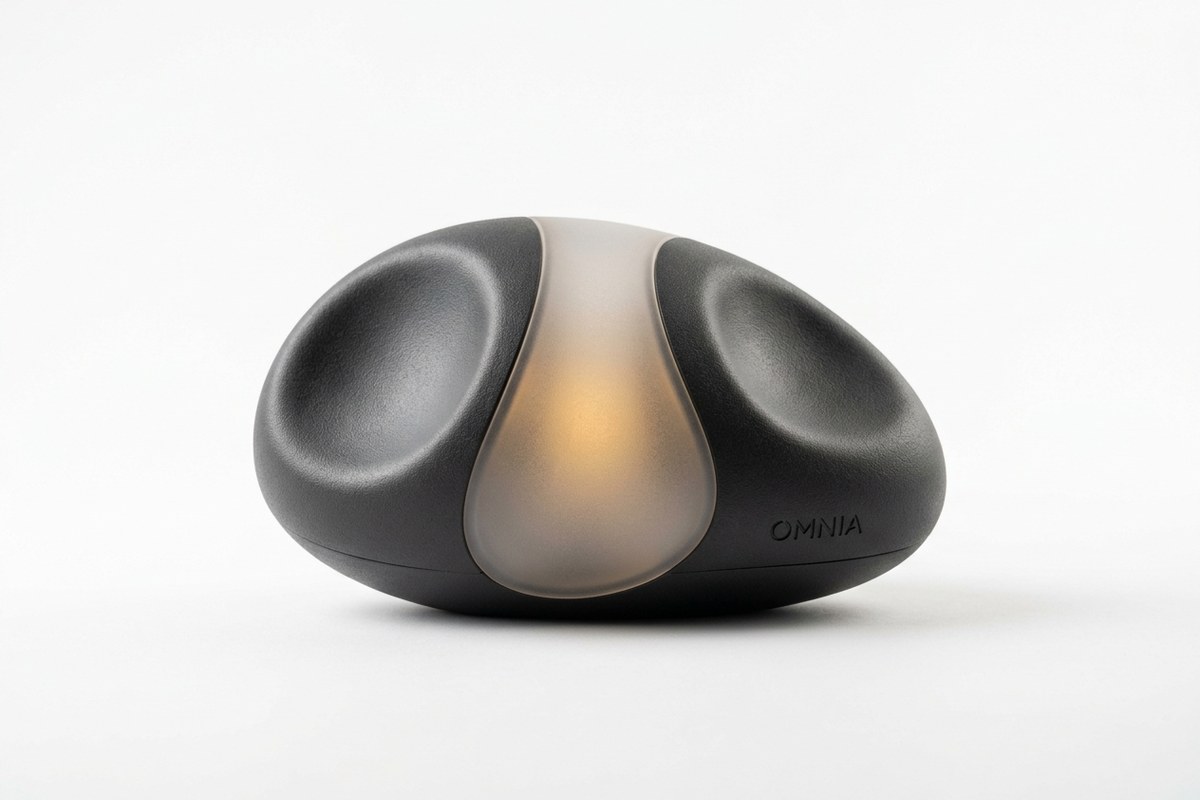
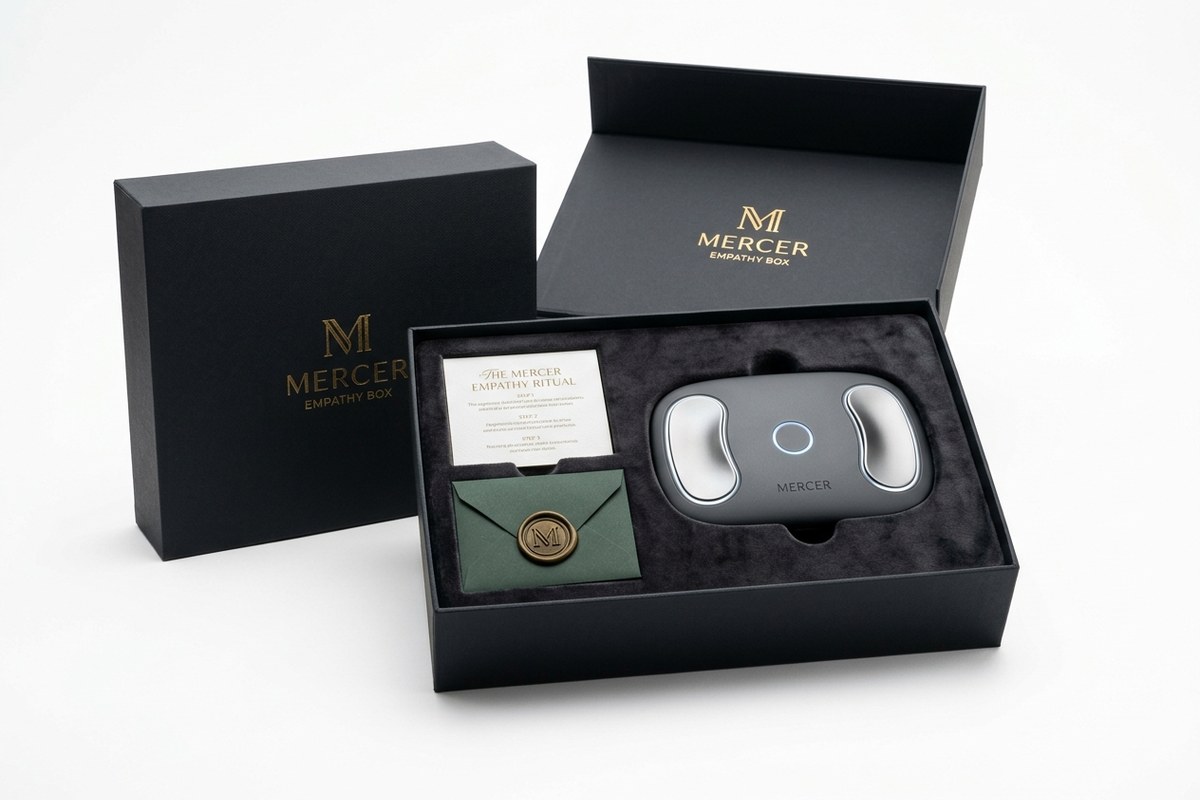
The Home Edition is a hardwood unit measuring 280mm × 180mm × 90mm and weighing 540 grams. Two grip handles extend from the sides; each grip is fitted with galvanic skin response sensors and grip pressure sensors that, together, measure arousal state and sustained engagement. The unit body contains a Peltier module that delivers gentle thermal feedback — warmth or coolness — to the user’s palms through the handles, calibrated in response to the aggregated session state of users currently connected to the Mercer Network.
A 40Hz ambient tone, audible only within approximately 30 centimetres of the unit, accompanies sessions. Sessions run from 10 to 40 minutes, configurable in the companion app. Cloud connectivity and the Mercer Network subscription — US$12 per month — are required for the synchronization feature; the unit functions as a biofeedback display only without an active subscription.
The hardwood construction is high quality. The grip handles are smooth and weighted. Holding the unit is, as an object-in-hand experience, well-considered.
In Practice
Over 34 sessions conducted across eight weeks — session length ranging from 15 to 30 minutes, typically in the morning — post-session calm scores measured on a standardized self-report scale improved in 28 of 34 sessions relative to pre-session baseline. The improvement averaged 1.4 points on a 10-point scale. This is a consistent result.
The confound is significant: 28 of 34 improvements over sessions of 15–30 minutes, conducted in quiet, grip-engaged, thermally stimulated stillness, are consistent with what any 20-minute quiet activity involving grip and thermal sensation would produce. Whether the improvement is produced by the Mercer Network synchronization, the Peltier thermal feedback, the galvanic skin response monitoring, the 40Hz tone, or simply sitting quietly for 20 minutes holding a warm object is not possible to isolate from the product as delivered.
The Mercer Network, when active, displays an aggregate “collective state” visualization in the app — a pulsing indicator representing the combined biofeedback of users currently in session worldwide. This visualization is present and updates continuously. Whether it produces the empathic resonance that Dick’s empathy box produced — the sense of shared experience, of collective suffering and collective endurance — is a question the product leaves to the user’s interpretation of a pulsing app graphic. The distance between these two things is, again, notable.
The Terms of Service warrant reading. Clause 14 describes the collection and use of aggregated physiological data — galvanic skin response and grip pressure — for “collective state computation and network experience modeling.” Clause 19 addresses data retention: physiological data is retained for “network modeling improvement” following subscription cancellation, with an opt-out available within 30 days. These clauses are disclosed. They are not in the first paragraph.
| Sensors | Galvanic skin response + grip pressure (both handles) |
| Thermal feedback | Peltier module (warm/cool, palm contact) |
| Ambient tone | 40Hz (audible within ~30cm) |
| Session length | 10–40 minutes |
| Network | Mercer Network subscription, US$12/month |
| Data | Aggregated physiological data collected (see ToS, clause 14) |
| Construction | Hardwood, 280mm × 180mm × 90mm |
| Weight | 540g |
Available through Off-World Imports; the unit ships in a cloth-lined box with a USB-C charging cable and a printed copy of the Terms of Service, which is longer than the getting-started guide.
- Genuinely calming as a 20-minute practice with consistent post-session improvement scores
- High-quality hardwood construction
- Network session concept is coherent even if the effect is non-specific
- Post-session calm scores improved in 28/34 sessions
- Effect difficult to isolate from any quiet 20-minute activity with grip and thermal sensation
- Physiological data collection terms deserve careful reading before purchase
- 'Collective state computation' is doing meaningful interpretive work
- US$640 before subscription
- Dick's empathy box produced shared wounds — this produces biofeedback
Dick’s empathy box left physical marks on its users. The rock cuts were real. The collective ascent was real in the sense that mattered to the characters — which is the sense Dick was most interested in. The Home Edition leaves users with improved calm scores and a subscription renewal date. This is a different product.
The rating of 3.9 reflects a well-made, genuinely calming object whose effect is real and whose source is ambiguous. If 20 minutes of quiet grip-and-thermal stillness produces consistent post-session calm regardless of mechanism, the mechanism question may be secondary to the outcome. US$640 plus US$12 per month is a significant investment in a practice whose benefit may be separable from the device. Whether the Mercer Network adds to the experience in a way that a warm wooden block does not is a question the product design does not make easy to answer.
Before purchasing, read clause 14. The empathy box in the novel merged users into shared experience. The Home Edition merges your galvanic skin data into a network model. The Terms of Service are the document in which this difference is most clearly described.