Unitree Go2 Robot Dog
A capable consumer quadruped robot with voice interaction, programmable movement, and an ability to follow you up stairs that takes some adjustment.
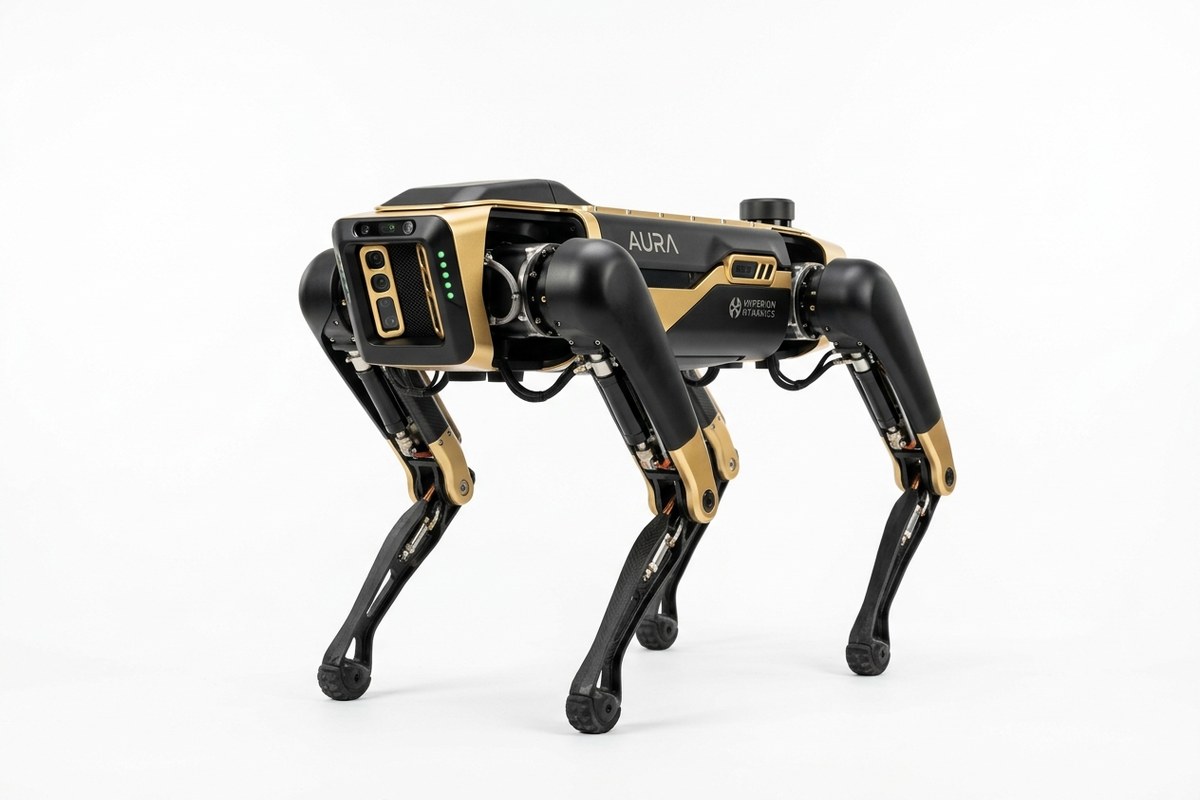
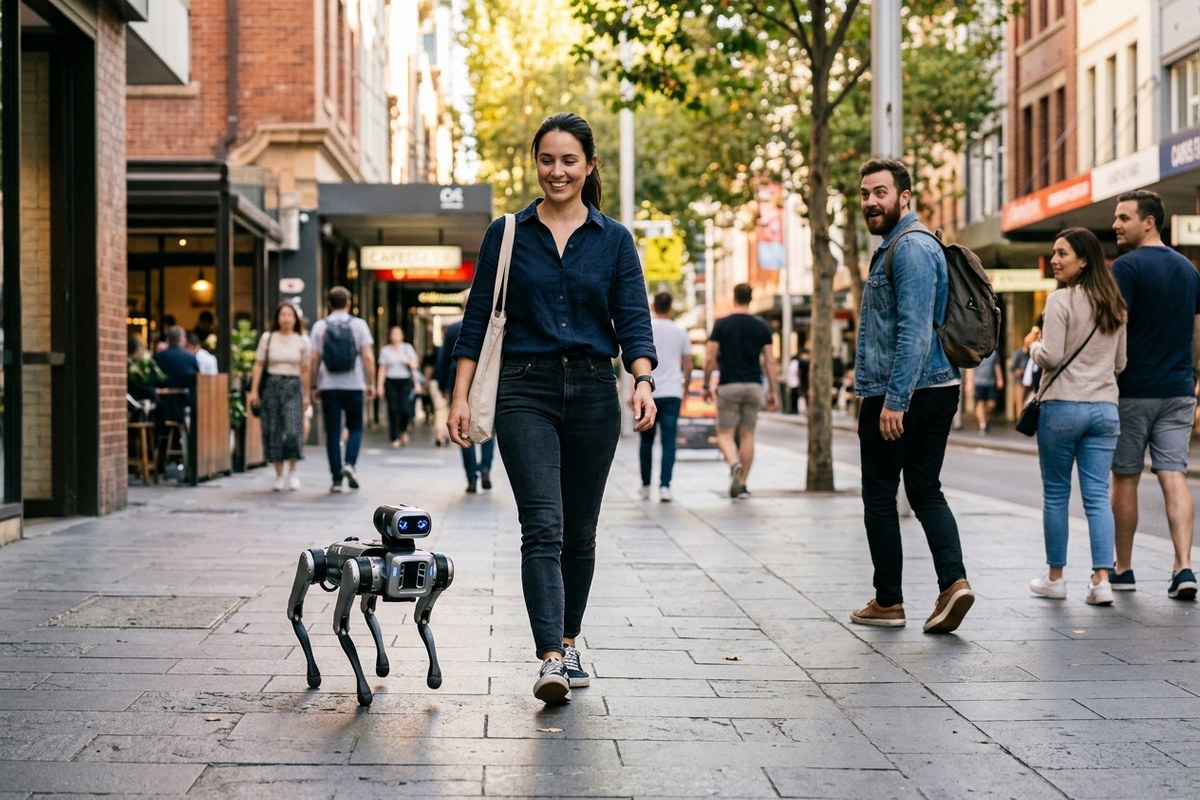
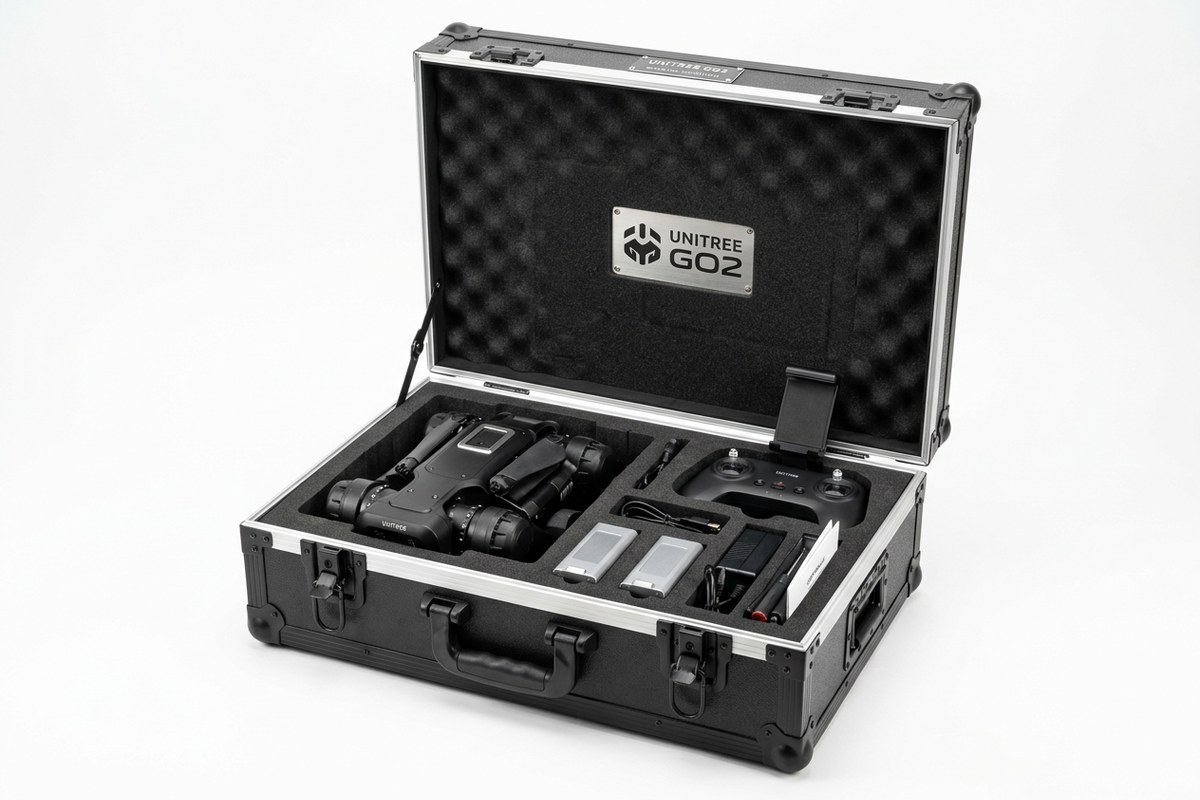
Ray Bradbury’s Mechanical Hound in Fahrenheit 451 (1953) is an eight-legged enforcement device that tracks targets by chemical signature and delivers a lethal injection at the end of its pursuit. It has no personality, no warmth, and no interest in sitting next to you while you work. It is, in other words, the precise opposite of the Unitree Go2, which has four legs, a camera face, voice recognition, and a follow mode that trails you from room to room with the muted enthusiasm of an animal that was designed to be liked.
The lineage from Bradbury’s creation to Unitree’s product is not a straight line, but the quadruped form factor for domestic robotics has its antecedents there, and in the Boston Dynamics machines that came between. The Go2 is notable for being the first serious consumer-grade quadruped — built well enough to be reliable, priced low enough to be purchasable, and programmable enough to be genuinely useful to developers. At US$1,600, it sits at a peculiar intersection of toy and tool.
What It Is
The Go2 is a quadruped robot standing 600mm at the back when upright. It has 12 degrees of freedom across its four legs, a front-facing depth camera, voice interaction via a built-in microphone array, Wi-Fi and Bluetooth connectivity, and an IP55 ingress protection rating. It weighs 15 kilograms, which is comparable to a medium-sized dog and has similar implications for picking it up.
The unit supports a 3-kilogram payload on its back, enabling accessories from additional cameras to custom sensor arrays. An active developer community has built a range of extensions and integrations; ROS2 support means the Go2 slots into existing robotics research frameworks without requiring proprietary adaptation. Unitree ships with a companion app for basic control and mode selection, but most advanced users will spend more time in their code editor than in the app.
In Practice
The movement quality is the first thing you notice. The Go2 navigates household environments — carpets, hardwood, door thresholds, shallow steps — with a fluency that earlier consumer robots did not approach. It does not glide; it walks, which sounds obvious but represents a decade of mechanical refinement compressed into a product that arrived at this price point in 2024. Follow mode, in which the robot tracks a designated person using the depth camera, works reliably in open spaces and manages hallway navigation without coaching.
Stairs present a different scenario. The Go2 handles gentle slopes and single steps competently. Standard residential stair runs of 10–12 steps at a 35-degree pitch require the robot to commit to a movement sequence that, the first time you watch it, produces an involuntary urge to spot it. It does not need spotting. It does need you to not be on the stairs at the same time.
The noise level on hard floors is significant. The Go2’s motors and gait produce a sound that is clearly mechanical and clearly persistent. In a carpeted environment, this diminishes to a background hum. On tile or hardwood in a quiet apartment at 11 PM, it is the dominant sound in the room. Neighbours below may have questions.
Voice recognition works in quiet conditions with standard commands. In environments with ambient sound — a television, a kitchen exhaust, a conversation — accuracy degrades noticeably. The microphone array handles clear speech at moderate distances; it does not handle background noise well. This is not an unusual limitation for voice-activated hardware, but it is worth knowing before purchasing a robot dog primarily for its conversation abilities.
Battery life under normal domestic use is 1 to 2 hours of active operation, with approximately 90 minutes to recharge. For a device that charges at the base station between uses, this works. For extended demonstrations or research sessions, the charging interval becomes a scheduling constraint.
| Weight | 15kg |
| Standing height | 600mm |
| Degrees of freedom | 12 |
| Battery (active use) | 1–2 hours |
| Charge time | ~90 minutes |
| Payload | 3kg |
| Connectivity | Wi-Fi, Bluetooth |
| Ingress protection | IP55 |
Available from Tannhäuser Supply Co.; shipping requires freight arrangements due to weight and dimensions.
- Movement quality impressive and genuinely fluid in domestic environments
- Voice and follow mode reliable in quiet conditions
- Build quality appropriate for the price point
- Active developer community and ROS2 support extend functionality significantly
- Motor noise on hard floors is significant and persistent
- Voice recognition degrades in ambient noise
- 1–2 hour battery life requires planning for extended use
- 15kg and 600mm height is substantial in small living spaces
The Go2 is, by a reasonable margin, the most capable consumer quadruped available at this price. Its movement is convincing, its build is solid, and the developer ecosystem around it transforms a novelty into a platform. The noise is the genuine friction point — not a flaw in a technical sense, but a lifestyle consideration that landlords, flatmates, and sleeping partners may weigh differently than the spec sheet does.
Bradbury’s Mechanical Hound tracked its targets relentlessly and silently. Unitree’s approximation does the tracking and skips the silence. In almost all respects, this is the preferable arrangement.